
Sustainability Disclosures
AB 1305 Disclosures
AB 1305 Disclosures
as of March 4, 2026
Galvanize Climate Solutions (“Galvanize”) is making the below disclosures in order to comply with California Assembly Bill Number 1305 (AB 1305). AB 1305 requires an entity that makes claims regarding the achievement of net zero emissions or other, similar claims to disclose on the entity’s website information documenting how, if at all, a claim was determined to be accurate or actually accomplished, how interim progress toward that goal is being measured, and whether there is independent third-party verification of the company data and claims listed.
I. Venture Climate Alliance
Galvanize is a member of the Venture Climate Alliance (VCA). The VCA is a group created by venture capital firms that aims to define, facilitate, and realize net zero-aligned pathways for early-stage investments. In joining the VCA, Galvanize committed to, among other things: inventory its direct Scope 1-3 carbon footprint and to reduce and/or neutralize its emissions for its own firm’s operations by 2030 or sooner. In April of 2024, the VCA established best practice methodologies and disclosure guidance with respect to venture capital portfolio company targets to achieve net zero alignment and firm reporting. Targets with respect to portfolio companies will be limited to the Innovation & Expansion strategy (I&E). More information can be found on VCA’s website regarding their methodologies and disclosure guidance.
I&E has formalized its goal of providing its portfolio companies with the guidance and resources needed to align their operations with Net Zero or negative greenhouse (“GHG”) emissions by 2050 or sooner.
I&E’s first iteration of its Net Zero targets reflects its commitment to transparency and rigor, and ambition to cultivate and support the next generation of climate-aligned market leaders. I&E will revisit these goals at a minimum of once every five years, with a view toward developing leading standards for measurement, targets, and transparency within the industry. Our targets:
- Galvanize will measure the Firm’s Scope 1-3 operational emissions using best-practice Greenhouse Gas accounting standards and take steps to reduce and/or neutralize our emissions by 2030 or earlier.
- In accordance with the stage-appropriate best practices defined by the VCA Portfolio Alignment Framework, I&E will encourage and support its portfolio companies to reach Net Zero alignment by 2050 or earlier.
- I&E will provide appropriate assistance to portfolio companies to help them achieve established Net Zero targets through its role as an advisor and shareholder.
- I&E will report annually on its progress and its portfolio’s progress toward the above goals, with the goal of bringing I&E’s full portfolio into alignment with Net Zero by 2050 or earlier.
Through our ongoing commitment to the VCA and its mission, we acknowledge the outsized role the venture industry can play in accelerating innovation and contributing to a low carbon economy. We aim to play our part in evolving industry best practices and standards for climate impact measurement, disclosure, and engagement, as well as fostering a collective goal of accelerating the global transition to Net Zero.
Galvanize has engaged an enterprise climate platform to annually estimate its carbon footprint since inception, which enables tracking progress toward our goal of net zero operational emissions by 2030 as defined by the VCA. As of December 2024, Galvanize conducted third-party verifications of such emissions accounting through the enterprise climate platform’s review of emissions outputs; however, Galvanize has yet to have the calculation audited by a third party.
Galvanize previously publicly disclosed its carbon footprint in the Galvanize Impact Framework, dated September 2023 (the “Impact Framework”). Specifically, Galvanize disclosed 1,449 tons of CO2e (see Glossary below) of operational emissions and 17,888 tons of CO2e of total financed emissions, in each case from August 2021 through December 2022.Galvanize seeks to address material emissions drivers across our operations where feasible. For residual emissions that are harder to abate, we pursue high-integrity carbon credit opportunities to address the remainder. In line with our target to reduce and/or neutralize our Scope 1-3 operational emissions by 2030 or earlier, we annually identify, evaluate, and purchase high-quality carbon credits to match these residual emissions. The summary below outlines the projects from which we have purchased credits to date, covering our Scope 1-3 operational emissions from inception through the year ended 2024.
More information pertaining to this carbon footprint and the calculation thereof can be found in the Impact Framework available at https://gw.galvanizeclimate.com/wp-content/uploads/2023/10/galvanize-impact-framework.pdf (see page 24).
II. General statements for each investment strategy
A. Innovation & Expansion
1. Strategy
Galvanize’s Innovation & Expansion strategy (I&E) aims to invest in and scale vital climate solutions driving timely decarbonization.
Galvanize estimates each company’s total addressable climate impact (TACI), planned impact, and realized impact (see Glossary below).
As of December 2025, Galvanize had not conducted a third-party verification of its TACI, planned impact, or realized impact estimates.
2. I&E Portfolio Company Emissions Abatement
Additionally, Galvanize publicly disclosed estimated 2022 I&E portfolio company emissions abatement in its 2023 Galvanize Impact Framework. Specifically, Galvanize disclosed ~4.9 million metric tons of CO2e abatement enabled in 2022 by 2022 I&E portfolio companies. More information pertaining to this calculation can be found in the Impact Framework available at https://gw.galvanizeclimate.com/wp-content/uploads/2023/10/galvanize-impact-framework.pdf (see page 9).
As of December 2025, Galvanize had not conducted a third-party verification of portfolio company emissions abatement.
B. Ponderosa
1. Strategy
With climate impact as an initial lens, Ponderosa looks for companies in the food and agriculture system with the potential for positive impact in the themes described above–biodiversity, water, human health, and justice. Ponderosa portfolio companies seek to reduce or avoid the negative impacts of conventional food and material production, decrease food waste and its associated emissions, promote regenerative agricultural practices, and/or revitalize natural carbon sinks.
When evaluating a company for investment, Ponderosa considers the TACI of each company. As of December 2025, Galvanize had not conducted a third-party verification of portfolio company emissions abatement or TACI.
C. Galvanize Global Equities
1. Strategy
Galvanize Global Equities (GGE) aims to catalyze an acceleration of energy transition (see Glossary below) and climate-aligned behaviors at portfolio companies. GGE utilizes third-party ESG data such as Integrum ESG and MSCI ESG ratings as sources to help measure and monitor a company’s transition risk assessment or alignment, in addition to its own research into a portfolio company’s practices.
At least once a year, a member of the GGE team runs the previously determined investment screens through a combination of data from Bloomberg and Equity Data Science. The companies that these screens identify are then further reviewed by the GGE team.
While there are no fixed rules relating to Transition alignment, GGE seeks investments that have accelerating capital allocation (fixed capital or operating expenditure) to aligned activities and a meaningful amount (ideally, >10%) of revenue and/or new capital formation focused on the net zero opportunity.
In addition, in June 2024 GGE announced its Net Zero targets, which will be revisited and revised at least once every five years. GGE’s Net Zero targets are set forth below:
- Measurement: GGE commits to annual measurement and transparent reporting on a range of portfolio- and asset-level metrics relating to portfolio company emissions, portfolio company alignment to the Energy Transition, and our engagement.
- Long-term GHG emissions reduction target: We aim to align our portfolio with Net Zero GHG emissions by 2050 or sooner.
- Near-term GHG intensity reduction target: By 2030, we aim to achieve a minimum 50% reduction in our portfolio Scope 1-2 weighted average carbon intensity (WACI, tCO2e/US$M invested) from a 2019 baseline.
- Engagement: We aim for at least 33% of current GGE companies to be the subject of direct, material[1] engagement.
As of December 2025, Galvanize had not conducted a third-party verification of portfolio company emissions abatement.
D. Galvanize Real Estate
1. Strategy
Galvanize Real Estate (GRE) aims to invest in and decarbonize real estate. GRE plans to reduce operational emissions of properties that it acquires. Specifically, GRE aims to reduce operational emissions of properties in its portfolio by 100% within three years of ownership. GRE measures quantitative reductions in operational CO2e emissions compared to a baseline, tracked through usage data from utility bills. An independent third-party consultant will validate this data.
As of December 2025, Galvanize does conduct a third-party verification of portfolio emissions abatement.
Glossary
- “CO2e” is a metric used to compare the emissions from various greenhouse gases on the basis of their global warming potential by converting amounts of other gases to the equivalent amount of carbon dioxide with the same global warming potential. GRE specifically tracks operational carbon dioxide (CO2), nitrous oxide (N2O) and methane (CH4) greenhouse gas emissions (collectively “CO2-equivalent emissions” or “CO2e emissions”) to calculate the fractional reduction of baseline portfolio emissions, or “fractional decarbonization.” This calculation includes portfolio properties’ emissions from metered fossil fuel burning on-site, emissions from net-metered electricity used on-site, and upstream methane emissions tied to metered natural gas usage. GRE also references CO2e emissions as “operational emissions.”
- “energy transition” is the transformation of the global economy required to comply with the Net Zero targets set in the Paris Agreement of 2015.
- “planned impact” is the future year-over-year climate impact that a business can practically deliver, compared to a business-as-usual baseline. It is not a goal or target, but represents Galvanize’s estimate of its expectations for the company’s ability to deliver climate impact.
- “realized impact” is the estimated actual climate impact of a company, calculated on an annual basis.
- “total addressable climate impact (TACI)” is the estimated tons of CO2 or its equivalents (CO2e) the company or other investment could directly or indirectly reduce, remove or avoid if it could capture 100% of the market as it stands today. For adaptation-oriented solutions, the TACI represents the total impact on the relevant resilience or adaptation metric (e.g., water use efficiency) if the company or other investment could capture 100% of the market as it stands today. TACI is not a measure of estimated or actual climate impact of the company or other investment in question. Rather, the purpose of TACI is to evaluate the magnitude of the climate transition pathway the company is addressing and help us focus on sectors, markets and products that truly matter.”
—
[1] “Material” engagement defined as active dialogue with portfolio company senior management, C-suite, and/or Board within the last 12 months.
Sustainability-related disclosures
Sustainability-related disclosures pursuant to the European Commission’s Regulation (EU) 2019/2088 on Sustainable Finance Disclosure Regulation (“SFDR”)
I. Sustainability Risks
Pursuant to the SFDR, “sustainability risks” are defined as environmental, social, or governance (ESG) events or conditions that, if they occur, could cause an actual or a potential material negative impact on the value of an investment.
Galvanize Climate Solutions LLC (“Galvanize”) is a climate-focused investment firm seeking to accelerate climate solutions and create long-term value for investors. As such, with respect to sustainability risks, Galvanize’s focus across its strategies will be more heavily weighted to sustainability risks related to climate impact.
Galvanize integrates sustainability risks in its decision-making process, in each case specific to the strategy’s investment processes. Sustainability risks form part of Galvanize’s risk evaluation and management process in connection with investment due diligence and portfolio management, in each case, in light of Galvanize’s evaluation of materiality to the investment and the circumstances of the investment (e.g., investment strategy, asset type, investment size, and stage of investment). Galvanize may elect to invest despite the existence of sustainability risks, such as where the sustainability risks may be mitigated or solved, or where such risks are determined to be immaterial or outweighed by other benefits.
II. Remuneration
The remuneration of team members is generally based on a combination of fixed and variable remuneration, which may be adjusted for performance. Galvanize encourages sound and effective risk management; however, we recognize that a willingness to take calculated risks is important to address the urgency of the climate crisis. With respect to senior investment professionals, investment performance may impact variable compensation via carried interest or incentive allocations. Sustainability risks may impact remuneration to the extent a material failure to consider sustainability risks adversely impacts investment performance.
Certain members of the team are also awarded carried interest, which may be based on performance or, in certain cases, achievement of sustainability metrics.
The below sets out sustainability-related disclosures for Galvanize Global Equities Fund (the “Fund”), a sub-fund of MontLake Oriel UCITS Platform ICAV (the “ICAV”), pursuant to the EU Sustainable Finance Disclosures Regulation (“SFDR”).
1. Summary
This section provides a summary of the website disclosures pursuant to the SFDR. It is provided for informational purposes only and, in the event of any inconsistency between this section and the website disclosures, the website disclosures shall prevail.
The Fund promotes an environmental characteristic but does not have as its objective sustainable investment. The environmental characteristic promoted by the Fund is the abatement of Green House Gas (“GHG”) emissions and climate change mitigation, i.e. curbing GHG emissions to reduce the amount of GHGs contaminating the atmosphere to meet the abatement required to meet the Paris Agreement targets (the “Transition”).
In order to achieve this, the Fund intends to invest in equities of companies across global equity markets, whose activities, the Investment Manager believes, will contribute to delivering the abatement in GHG emissions required to meet the Transition or whose activities will benefit from participation in the Transition.
The Investment Manager undertakes to understand and monitor portfolio companies’ abatement against net zero targets. The Investment Manager intends to place more emphasis on rates of change in portfolio companies’ carbon emissions against current emissions levels and on those companies’ long-term plans.
In order to evaluate the above, the Investment Manager will draw from research into a portfolio company’s practices, which may include a company’s annual filings, quarterly filings, sustainability reports, or third party research. In addition, the Investment Manager will draw from trusted ESG data sources such as Integrum ESG, MSCI and Bloomberg ESG, to create the Galvanize Climate Transition Score (the “GCT Score”) for each portfolio company that will form the basis for determining the extent to which each portfolio company is aligned with the goals of the Transition. Specifically, the Investment Manager refers to Integrum ESG (a licensee of SASB Inside and Minerva Analytics) and MSCI ESG Ratings to calculate the GCT Score. The scoring ranges from A1 to D4 with a score of A1 indicating a company has high transition alignment and environmental performance, whereas a D4 score would indicate a company has low transition alignment and environmental performance.
The proprietary composite score will help inform the transition risk assessment or alignment of each portfolio company, including the extent to which each portfolio company is aligned with the goals of the Transition and/or is on a trajectory consistent with any public commitment it has made in respect of the Transition, as well as the team’s level of conviction that they can engage with a company towards climate alignment to the extent engagement may be required.
Further detail on the Fund’s investment strategy is described below.
Galvanize Climate Solutions LLC (the “Investment Manager”) intends to investment a minimum of 95% of the Fund’s net asset value in investments which are aligned with the environmental characteristics promoted by the Fund, of which 20% is planned to be invested in sustainable investments.
The Investment Manager undertakes to understand and monitor portfolio companies’ abatement against net zero targets. The Investment Manager intends to place more emphasis on rates of change in portfolio companies’ carbon emissions against current emissions levels and on those companies’ long-term plans.
Data sources used to attain environmental or social characteristics promoted may include both proprietary information and third party data providers as described in further detail below. Whilst it is recognised that data availability may impact the extent to which environmental or social characteristics promoted can be measured, this is managed through the use of both proprietary data and data sourced from third party data providers generally with broad capabilities and coverage.
The Fund’s engagement with select portfolio companies is expected to be an important element of the Fund’s strategy. The Investment Manager intends to make the Fund’s objectives and expectations clear to those portfolio companies early in the investment cycle. The Fund is expected to benefit from the Investment Manager’s insights on key aspects (commercial, technological, and regulatory) of the Transition and, therefore, is expected to be well placed to influence companies as they explore their own strategies and policies on these subjects. The Fund will seek to bring the Investment Manager’s resources and credibility to the table in order to catalyze change at select portfolio companies.
The Fund does not have a ‘Designated reference benchmark’ to attain the environmental or social characteristics promoted.
2. No Sustainable Investment Objective
This Fund promotes environmental or social characteristics, but does not have as its objective sustainable investment.
3. Environmental or social characteristics of the financial product
The environmental characteristic promoted by the Fund is the abatement of GHG emissions and climate change mitigation, i.e. curbing GHG emissions to reduce the amount of GHGs contaminating the atmosphere to meet the Transition.
The Fund does not have a reference benchmark designated for the purpose of attaining the environmental or social characteristics promoted.
4. Investment Strategy
4.1 What is the investment strategy used to meet the environmental or social characteristics promoted?
The Investment Manager intends to drive the Fund’s returns by investing in equities of portfolio companies across global equity markets that the Investment Manager believes will either directly benefit from their participation in the energy transition contemplated under the Paris Agreement, or whose activities the Investment Manager believes will contribute to delivering the abatement required to meet the Transition. While the Investment Manager will seek to manage the Fund based on a “double bottom line” which consists of taking into account both pure economic performance and alignment with the goals of the Transition, the Investment Manager believes that portfolio companies aligned with the Transition will reap significant economic rewards in our rapidly changing world and generate long-term capital growth for the Fund.
The Fund will be actively managed through a combination of fundamental equity research organized according to sector exposures and Transition pathways. The Fund’s portfolio is expected to be diversified across industries and geographies, with no particular geographic focus intended. The average investment horizon (i.e., the length of time for which an investment will be held) is expected to be three years.
The Investment Manager expects that portfolio companies should display some or all of the following attributes:
- Public Commitment – company management will have identified publicly that the Transition is a major part of the portfolio company’s strategy;
- Capital Allocation – a significant portion of new capital will be allocated towards Transition aligned activities; and
- Ripple Effect – impact will be amplified by actions to influence supply chain and customer behaviour to enhance societal Transition alignment.
In managing the Fund, the Investment Manager intends to engage with select portfolio companies to accelerate and support the Transition. The Investment Manager may also seek to collaborate with portfolio companies to enable them to measure, disclose, and target carbon emissions. In particular, the Investment Manager believes that adopting Scope 3 measures and targets (i.e. measures and targets that aim to reduce indirect emissions that occur in a company’s value chain) is a necessary mechanism to enforce alignment throughout the value chain. In selected cases, the Fund also intends to advocate for change of capital allocation policies and corporate strategy to deliver enhanced financial return and accelerated GHG abatement. The Fund will also aim to harness the resources of the Investment Manager’s eco-system to deliver impact at portfolio companies.
The Investment Manager believes that aspects of the Transition will evolve over time, and that the Investment Manager’s investment universe and the processes it uses to identify investments will also evolve. However, the Investment Manager intends for the Fund’s investments to always be aligned with the goal of addressing the effects of global warming.
The Fund generally intends to segment the investable universe of potential portfolio companies into three categories based on their Transition characteristics.
- Transition Franchises are scaled, market-leading companies that the Investment Manager believes can offer sustainably high returns on capital, strong alignment to the Transition in capital allocation and accelerating top line growth in these activities.
- Transition Improvers are companies with an important role to play in the Transition and that are early in their journey of adaption. Transition Improvers include companies with significant emissions in their operational activities, large Scope 3 footprints that need addressing and legacy companies attacking the opportunity of the Transition with significant capital allocation to new business lines that have not yet scaled. When investing in Transition Improvers, the Fund will seek to influence the speed and ambition of this improvement by bringing the resources of the Investment Manager to bear in order to deliver rigorous, informed and constructive engagement intended to have an impact on the corporate outcome.
- Transition Enablers are companies that the Investment Manager believes are allocating (or will allocate) a significant portion of their capital towards services, technologies or products specifically intended to deliver the Transition. Transition Enablers will typically exhibit faster growth and less maturity in their profit path – and so may present greater investment risk – but will be attacking a very large addressable market with an innovative approach to delivering carbon abatement. The Fund will also include renewable developers in this category. The Investment Manager believes that its science team’s domain expertise will prove a crucial, differentiating resource when evaluating companies in this category.
4.2 What is the policy to assess good governance practices of the investee companies?
The Investment Manager will assess governance factors for each portfolio company based on third party data, from providers such as Minerva Analytics and Bloomberg ESG. Specifically, the team reviews industry-accepted ratings that incorporate governance considerations as part of the vetting process for potential investments.
Governance considerations include: (i) sound management structures; (ii) employee relations; (iii) remuneration of staff; and (iv) tax compliance (including penalties, fines or other liability arising from breaches of applicable tax law).
5. Proportion of Investments
95% of the planned asset allocation of the Fund will fall within category #1 “Aligned with E/S characteristics”, of which, 20% is planned to be sustainable investments falling within category #1A “Sustainable”. The remaining 5% of the Fund is expected to fall within category #2 Other.
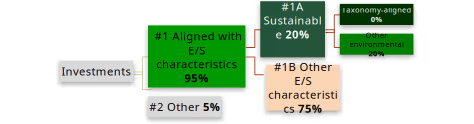
#1 Aligned with E/S characteristics includes the investments of the financial product used to attain the environmental or social characteristics promoted by the financial product.
#2 Other includes the remaining investments of the financial product which are neither aligned with the environmental or social characteristics, nor are qualified as sustainable investments.
The category #1 Aligned with E/S characteristics covers:
– The sub-category #1A Sustainable covers sustainable investments with environmental or social objectives.
– The sub-category #1B Other E/S characteristics covers investments aligned with the environmental or social characteristics that do not qualify as sustainable investments.
As at the date of this disclosure, the Fund does not commit to invest in any “sustainable investments” within the meaning of the Taxonomy Regulation. The minimum share of investments in transitional and enabling activities within the meaning of the Taxonomy Regulation is therefore set at 0% of the Fund’s Net Asset Value.
6. Monitoring of environmental or social characteristics
The Investment Manager undertakes to understand and monitor portfolio companies’ abatement against net zero targets. The Investment Manager intends to place more emphasis on rates of change in portfolio companies’ carbon emissions against current emissions levels and on those companies’ long-term plans.
With respect to each portfolio company, the Investment Manager intends to periodically monitor such company’s abatement against net zero targets and periodically update the proprietary composite score to reflect relevant changes. Notably, some of the Fund’s portfolio companies, particularly those in the Transition Improvers category, may be relatively large generators of greenhouse gas emissions, at least at the time of an initial investment. In addition, the Investment Manager may hold investments in portfolio companies that fail to meet stated emissions targets, or which have revised and/or extended their deadlines to achieve those targets.
7. Methodologies for environmental or social characteristics
The Investment Manager undertakes to understand and monitor portfolio companies’ abatement against net zero targets. The Investment Manager intends to place more emphasis on rates of change in portfolio companies’ carbon emissions against current emissions levels and on those companies’ long-term plans.
In order to evaluate the above, the Investment Manager will draw from research into a portfolio company’s practices, which may include a company’s annual filings, quarterly filings, sustainability reports, or third party research. In addition, the Investment Manager will draw from trusted ESG data sources to create a proprietary composite score for each portfolio company.
This proprietary composite score will help inform the transition risk assessment or alignment of each portfolio company, including the extent to which each portfolio company is aligned with the goals of the Transition and/or is on a trajectory consistent with any public commitment it has made in respect of the Transition, as well as the team’s level of conviction that they can engage with a company towards climate alignment to the extent engagement may be required.
8. Data sources and processing
The ESG indicators used to measure attainment of the environmental and social characteristics promoted by the Fund are drawn from third-party data sets overseen by the Investment Manager.
- Integrum ESG, MSCI and/or Bloomberg ESG are used to form the basis for determining the extent to which each portfolio company is aligned with the goals of the Transition.
- The Investment Manager specifically refers to Integrum ESG (a licensee of SASB Inside and Minerva Analytics) and MSCI ESG Ratings to calculate the GCT Score.
- The Investment Manager uses third party data, from providers such as Minerva Analytics and Bloomberg ESG to assess governance factors for each portfolio company.
- The Investment Manager refers to Integrum ESG, a leading independent ESG data analyst and provider, which uses research and frameworks of leading organisations, including the impact framework developed by the University of Cambridge Institute for Sustainability Leadership (2019) “In search of impact: Measuring the full value of capital. Update: The Sustainable Investment Framework” to score a company’s alignment with the UN Sustainable Development Goals.
To ensure data quality, the Investment Manager’s investment team reviews its work to identify reputable data providers, such as industry-accepted ratings methodologies, research, and analysis. In addition, where appropriate, the investment team may leverage the Investment Manager science team’s domain expertise to help evaluate and digest data.
The Investment Manager will draw from the data sources listed above, to create a proprietary composite score for each portfolio company.
The Investment Manager may use both reported and estimated data in its evaluations, which includes reported and estimated data from portfolio companies and third party data providers. The proportion of data that is estimated will vary depending on the individual portfolio company and data sources available. For example, Scope 3 emissions data is often difficult to measure and therefore may often be estimated.
9. Limitations to methodologies and data
In making investments decisions, the Investment Manager will conduct inquiries and undertake due diligence that it considers appropriate under the particular circumstances of those decisions. It will attempt to evaluate complex business, financial, tax, accounting, environmental and legal issues and will seek information to allow it to do so. The Investment Manager will rely on the resources reasonably available to it, and, in particular, will rely heavily on the accuracy and completeness of information provided by third parties. However, often it will not be in a position to confirm that completeness or accuracy: particularly in the face of fast-moving developments, critical, and apparently reliable, information may be inaccurate or incomplete. The Investment Manager’s due diligence inquiries may not reveal or highlight matters that could affect its decision making, and its evaluation of information it does have may be flawed, with potentially material adverse effects on the Fund’s portfolio and the value of its investments.
10. Due Diligence
The Investment Manager utilizes (a) primary and secondary research, (b) analyst sector, industry and geographic expertise and (c) industry-accepted ratings methodologies as part of the vetting process for potential investments.
The investment team performs due diligence using some or all of the following: primary contact with companies, competitors and suppliers; third-party confirmations via industry experts; and interaction with investment banking analysts, other participants in the companies’ ecosystems and resources at the Investment Manager.
In addition, the team reviews a company’s annual filings, quarterly filings, and/or sustainability reports. With this information, the Investment Manager analysts review the company’s progress on its decarbonization commitments, if any.
11. Engagement Policies
The Investment Manager’s engagement with select portfolio companies is expected to be an important element of the Fund’s strategy. The Investment Manager intends to make the Fund’s objectives and expectations clear to those portfolio companies early in the investment cycle. The Fund is expected to benefit from the Investment Manager’s insights on key aspects (commercial, technological, and regulatory) of the Transition and, therefore, is expected to be well placed to influence companies as they explore their own strategies and policies on these subjects. The Fund will seek to bring the Investment Manager’s resources and credibility to the table in order to catalyze change at select portfolio companies.
The framework used to select and engage with potential portfolio companies will also draw from multiple resources, including company sustainability reports, company interactions, ESG analytics tools and other data provider analytics selected by the Investment Manager at its discretion. Using these sources, the Investment Manager will form a composite score, the GCT Score for each portfolio company that will form the basis for determining the extent to which each portfolio company is aligned with the goals of the Transition. Specifically, the Investment Manager refers to Integrum ESG (a licensee of SASB Inside and Minerva Analytics) and MSCI ESG Ratings to calculate the GCT Score. The scoring ranges from A1 to D4 with a score of A1 indicating a company has high transition alignment and environmental performance, whereas a D4 score would indicate a company has low transition alignment and environmental performance. Integrum ESG is an ESG software provider which uses its own “Sovereign ESG Assessment Framework” to assess ESG performance using a focused set of metrics that are informed by data from reputable, international non-profit organisations.
When the Investment Manager engages with a portfolio company, the Investment Manager expects to do so along some or all of the following dimensions:
- Measure, disclose and target carbon emissions – for relevant portfolio companies, the Fund will have a set of “asks” relating to disclosures and GHG targeting using industry frameworks such as the Task Force on Climate Related Financial Disclosures (“TCFD”) and the Science Based Targets Initiative (“SBTi”) (or others that may be developed in the future) to guide corporate behaviour. The TCFD develops recommendations on the types of information that companies should disclose to support investors, lenders, and insurance underwriters in appropriately assessing and pricing a specific set of risks related to climate change. The SBTi is a corporate climate action organisation that enables companies and financial institutions worldwide to play their part in combating the climate crisis.
- Advocate for change of capital allocation policies and corporate strategy – for select investments in the Fund’s portfolio, the Investment Manager will seek to have more direct influence on capital allocation to accelerate the Transition. This may include working to persuade certain portfolio companies to reduce their allocations to polluting activities and/or increase allocations to remedies/adaption. The Investment Manager may also seek to advocate for changes to certain portfolio companies’ corporate governance, including proposals to adjust executive compensation policies to reward the delivery of abatement. The Investment Manager will aim to collaborate with portfolio companies rather than fight proxy battles.
12. Designated Reference Benchmark
No index has been designated as a reference benchmark to meet the environmental or social characteristics promoted by the Fund.
FUND: Galvanize Global Equities Fund (the “Fund”)
LEI: 635400ENZRFLPGQJRQ80
ISIN: N/A
MANAGEMENT COMPANY: Waystone Management Company (IE) Limited (the “Manager“)
